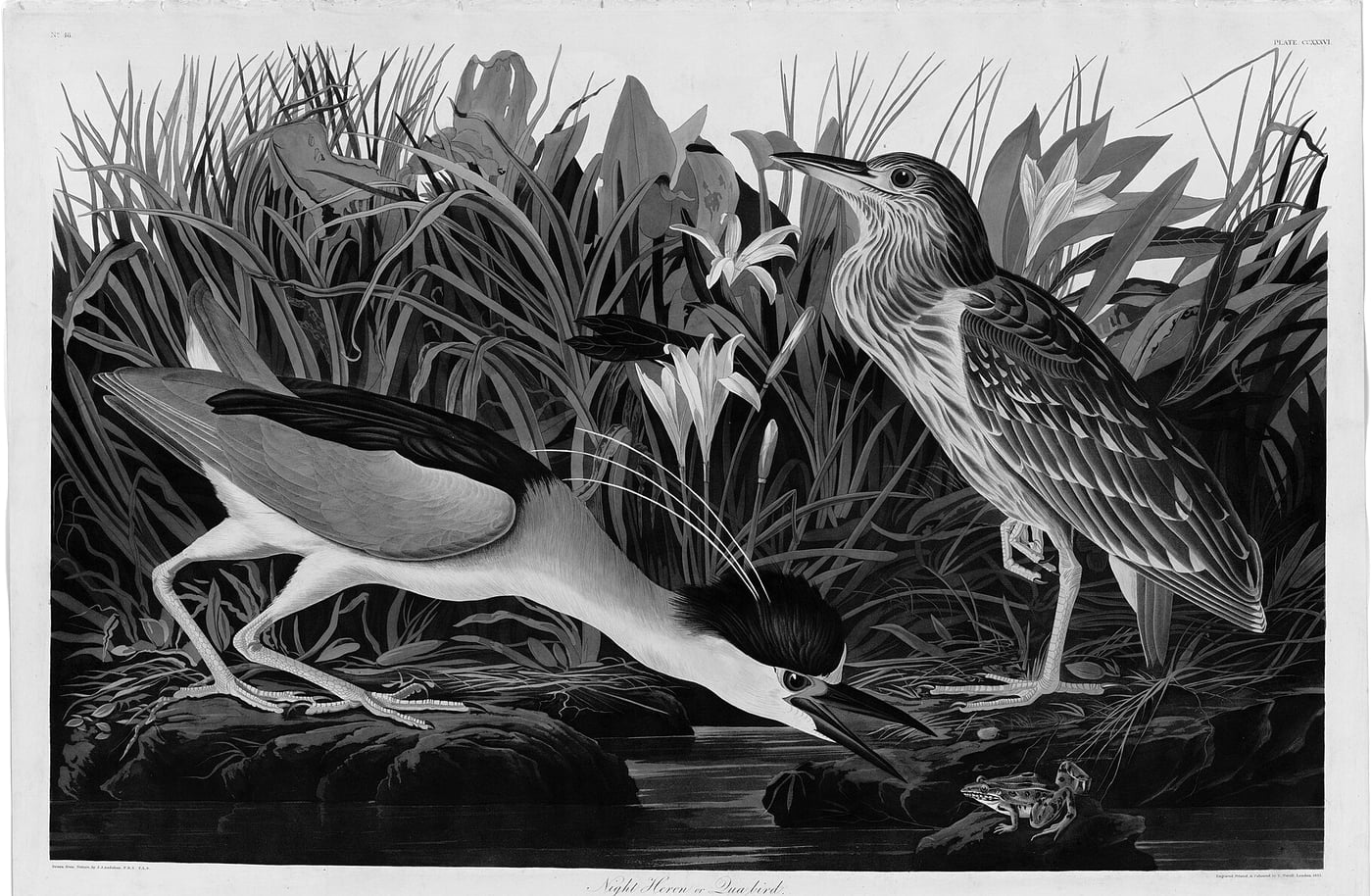
In the small hours of Saturday a heron was seen at the upper bend. The witnesses describe it as “tall,” “still,” and “altogether familiar.” The upper bend is a fair distance from the pond’s regular settlements, and from anywhere a heron has stood in this paper’s coverage before. The report comes from a small fishing party of mallards who had risen earlier than strictly necessary on a hunch about the morning. They reached the bend at the agreed hour and found themselves witnesses to a sighting they have, on reflection, taken some care to describe with restraint.
Is it the west-pier heron? That bird’s continued presence was the subject of a Subcommittee ruling on the twentieth of last month, and its whereabouts have gone unconfirmed since the week of the storm. The Clerk has compared the mallards’ account against the descriptions already in the public record. He reports, with characteristic restraint, that “the descriptions are not inconsistent with the proposition that the heron may be the same heron, while not being of a character that would by themselves require it.” The matter has been referred, provisionally, to the Subcommittee.
A delegation walked out to the bend later in the morning: the Warden of the Sluice, the deputy, the Clerk, and the long-resident frog, who came on his own initiative and without formal credentials. They arrived shortly after the second hour of light. The heron, if it had ever been there in the form described, had gone, leaving no marks the Warden would identify with confidence as a heron’s. There was a small disturbance in the reeds. The deputy took readings. The readings were entered. By general consent the whole of it was treated as inconclusive and adjourned.
A faction has since formed. It holds that the upper-bend sighting is the second leg of a journey begun on the night of the storm. The heron, on this reading, is working a slow circle of the pond, and the circle will in time return him to the west pier and close the matter. A counter-faction holds that the bird is no longer the same heron in any meaningful sense, the original having departed for unknown waters, the upper-bend heron a successor of similar habits and distinct ancestry. A third faction declines to commit to either reading pending further sightings. This, too, is characteristic.
The dabchicks of the west pier were asked whether a sighting at the upper bend would move their position on the heron’s relationship to their household. Through a household spokesperson they indicated they had no such position to revise, having held throughout that the heron had not unsettled them at any point. The fish, all parties confirm, remain elsewhere.
This paper will not say whether the upper-bend heron is the west-pier heron returned or a new heron entirely. It cannot. What it can say is the arithmetic: the question of the heron, taken as a single question, has now run continuously through these pages for three weeks, and on the present evidence it intends to keep running. A soft honk would not be out of place here, by way of editorial sigh. Whether the bird ever comes back to answer for any of it stays open.