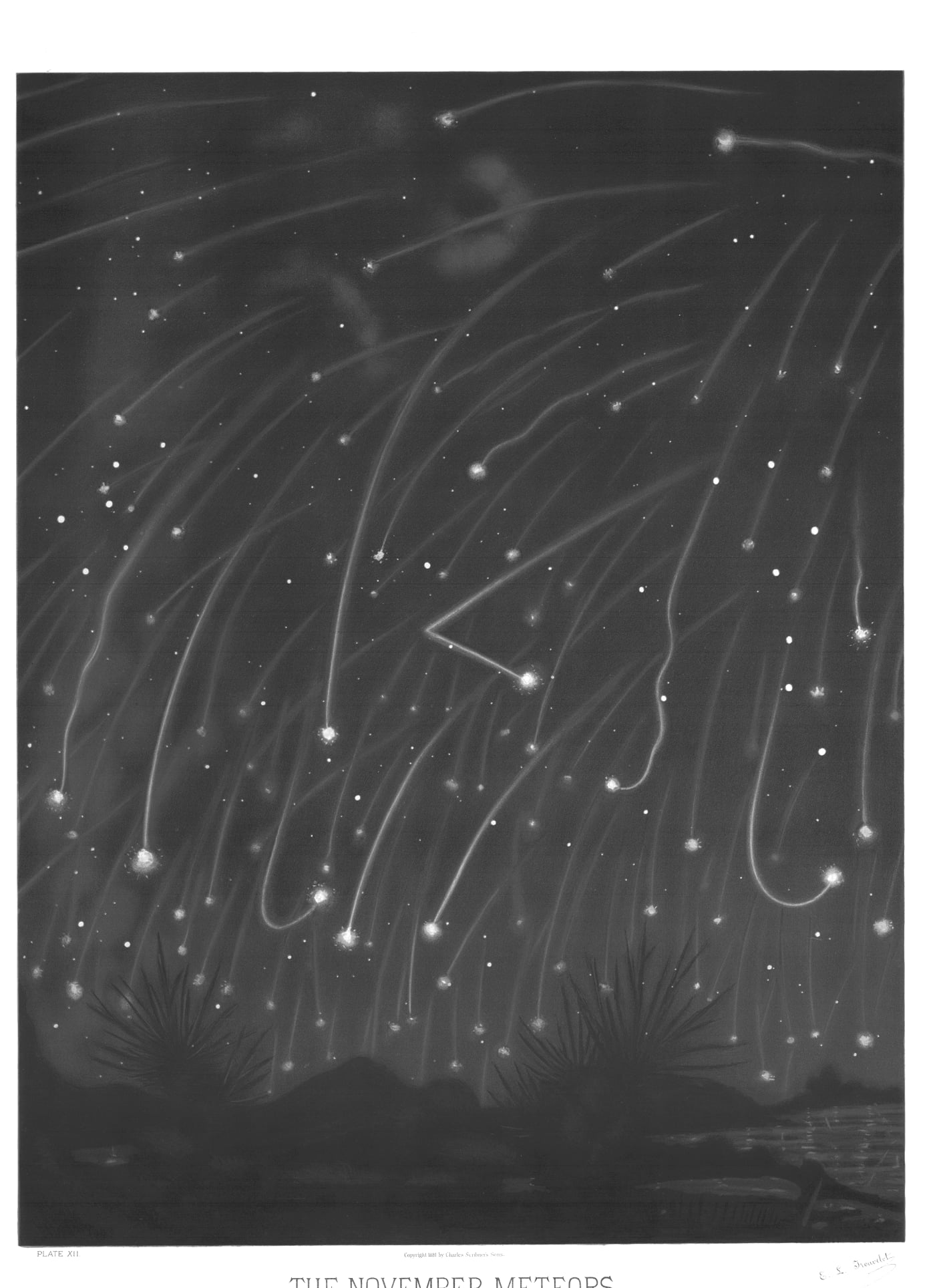
The Perseid meteor shower was watched across the pond on Wednesday evening, conditions allowing. I was one of a small standing party assembled on the south bank for the purpose. We held the watch from the close of the late twilight to the point at which I confessed myself no longer reliably awake. The first meteor came at about the second honk of the evening. That is a phrase the gazette has used before only of the morning, and I extend it to the late hour at my own risk. A second followed within two breaths. A third came after a longer wait. After that they fell at intervals not evenly spaced but enough, in the aggregate, to make what the older drakes were willing to call “a shower, of a sort.” The thickest of it came at the first watch. Then the meteors thinned, trailing off toward dawn.
The older drakes had taken their station along the south bank’s western edge as the late afternoon drew down, and they weighed the shower at length. The substance of the talk did not carry to my observing distance. The character of it did, and the gist came clear. The shower, in their judgment, fell short of the shower of three winters past. That one (I gather, hearing of it for the first time) had been watched over unusually still water. It had thrown meteors at a spacing one of them called “regular without being predictable,” and it had ended on a single very bright meteor, brighter, the eldest swore, than any since. This year’s was, beside that one, thin in the middle hour and ragged at the close. It was short, too, on what one of them called the “very bright,” and the usual qualifications were entered. Chief among them was that the season of comparison was one in which the older drakes had been younger drakes. The verdict held. This year’s was the lesser.
While the shower ran, at an hour I can fix at the third honk of the evening, a report reached the south bank. A drake of no particular acquaintance, who had crossed from the upper end of the channel to bring it, said the lights at the upper bend had been seen again. The arrangement was the one the fishing party of mallards have given every time before: three lights, small and steady, about a wing-span above the water. The hour was a little ahead of the shower’s peak. The showing was brief. The gazette logs it as the fourth sighting now on record, falling on the same night as the Perseids.
The older drakes, asked about it, offered, helpfully and unbidden, a theory I had not heard them put before. The lights, they said, may be no lights at all, but Perseids thrown back by the water at an angle peculiar to the upper bend. The curve of the pond’s course is sharper there than anywhere else along it. On a clear night, they reasoned, the surface might hand its meteors back at an altitude one does not expect. The theory was offered, as the older drakes offer most things, without insistence. I considered it. I consider it still. It is, and the gazette sets this down with care, a tidy theory. It does the work of both puzzles with one part. It puts no party in the wrong, requires no instrument to be missing, and asks no stretch of the pond to be anything other than the pond.
It does not, I have to report, satisfy me.
The lights, the fishing party have said each time, were not the moon. The arrangement held steady, and the showing had a clean beginning and end. The angle the older drakes propose would want the lights at their most numerous when the meteors are most numerous, not at their least. So I set the theory and the doubt down side by side, and I leave the question where I found it: unanswered, and worth answering.
The Perseids were seen. The lights were seen. The pond, in the small dark hour, was very still, and gave nothing away.